
Quotation
How to negotiate price and MOQ with a China supplier
How to negotiate unit price, MOQ, price breaks, packaging tradeoffs, and payment terms with a China supplier without weakening quality control.
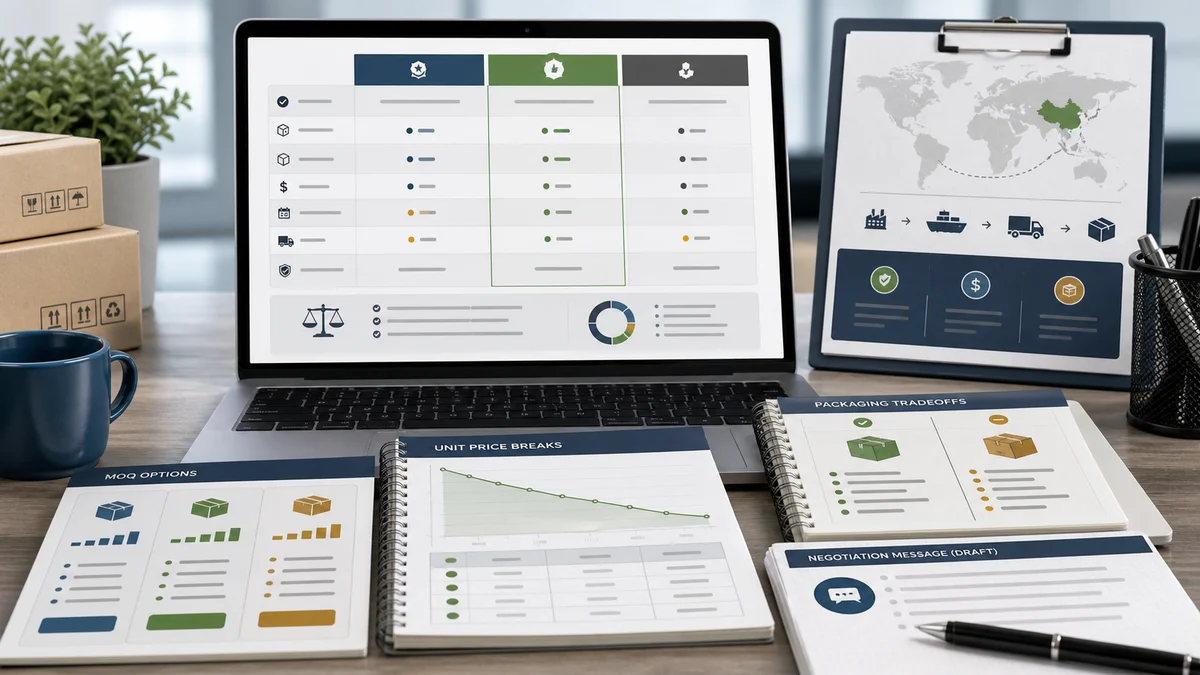
Price and MOQ negotiation works best when the buyer understands what drives the supplier’s cost. Pushing for a lower number without changing scope often creates hidden risk: thinner material, weaker packaging, delayed production, or less attention to quality.
The goal is not to win one argument. The goal is to reach a price, quantity, and production scope that the supplier can actually deliver.
Normalize the quote before negotiating
Do not negotiate from an unclear quote. Confirm specification, material, dimensions, finish, packaging, labeling, testing, Incoterms, lead time, payment terms, tooling, and sample status first.
If two suppliers quote different assumptions, the cheaper offer may not be cheaper. Use the same brief and compare the same fields. This connects directly to how to compare China supplier quotes.
Ask what drives the MOQ
MOQ is usually driven by material order quantity, machine setup, packaging print runs, labor setup, supplier policy, or the supplier’s willingness to prioritize the order. Ask which part of the MOQ is fixed and which part is flexible.
You may be able to reduce MOQ by accepting standard material, simple packaging, neutral cartons, fewer color variants, a longer lead time, or a slightly higher unit price. If custom packaging or tooling is involved, separate product MOQ from packaging MOQ.
MOQ questions to ask
- Is the MOQ driven by raw material, packaging, machine setup, or policy?
- What is the lowest trial order quantity with a higher unit price?
- Can standard packaging reduce the first-order MOQ?
- Can colors, sizes, or SKUs be consolidated?
- What price breaks apply at higher quantities?
These questions help the supplier explain the constraint instead of simply refusing.
Use price breaks instead of one target price
Ask for a price table at several quantities. For example: trial order, normal order, and scale order. This shows where the real cost changes happen.
Price breaks also make negotiation more professional. Instead of saying “too expensive,” the buyer can say: “Please quote 500, 1,000, and 3,000 units with the same specification, FOB terms, and standard packaging.”
If the supplier cannot reduce unit price, ask whether it can improve payment terms, sample cost credit, tooling refund, packaging inclusion, inspection support, or lead time.
Do not negotiate away quality controls
Avoid savings that remove inspection, weaken packaging, change material without approval, or skip sample confirmation. A lower price is not useful if it creates defects, claims, or customs problems later.
Write any cost-saving change into the order file. If the supplier proposes a cheaper material, record the new material, sample requirement, acceptance criteria, and price difference. Do not rely on chat shorthand.
Frame the negotiation professionally
Suppliers take buyers more seriously when the request is specific. Share the target quantity, expected repeat volume if real, decision timeline, required specification, and what can be flexible.
A practical message:
We are comparing suppliers for this specification. Please quote 500, 1,000, and 3,000 units with FOB terms, standard export packaging, and lead time after sample approval. If MOQ can be reduced for a first trial order, please show the unit price difference and what conditions change.
Do not invent fake volume or fake competitor prices. If the supplier discovers the bluff, trust drops and future cooperation becomes harder.
Know when a higher price is better
A supplier with a slightly higher price may be the better choice if communication is clear, sample quality is stronger, documents are consistent, and inspection terms are accepted. Negotiation should include operational risk, not only unit cost.
For first orders, it is often better to negotiate a controlled trial order than to force the lowest possible mass-production price too early.