
Supplier selection
Trading company vs factory in China sourcing
How B2B buyers can compare trading companies and factories in China by transparency, control, price, communication, and order risk.
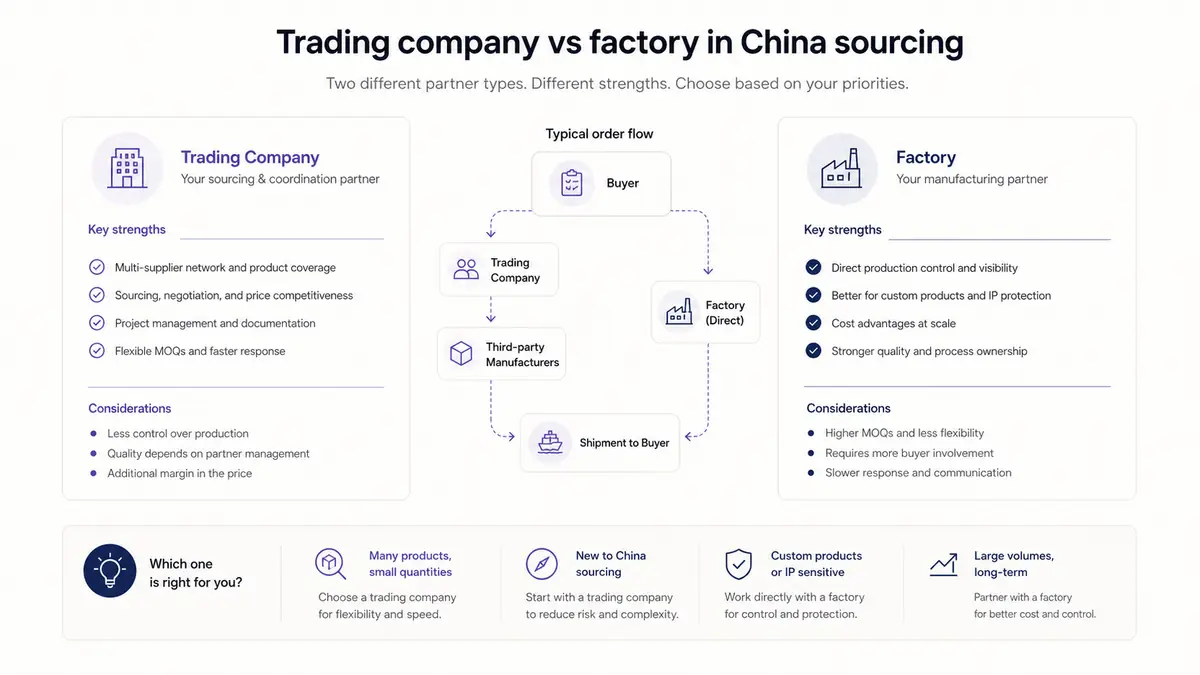
Many buyers assume a factory is always better than a trading company. In practice, the right choice depends on product complexity, order size, supplier transparency, and the buyer’s control needs.
For a three-way decision that includes sourcing agents, use the factory vs trading company vs sourcing agent guide.
When a factory is preferable
A direct factory relationship is usually better when the product is technical, customized, repeatable, or quality-sensitive. Direct access can improve engineering feedback, sample control, and production visibility.
Factories can also be better when the buyer needs stable repeat production, direct discussion of process changes, or clearer accountability for defects. The tradeoff is that some factories are less flexible with small orders, mixed product lines, export documentation, or buyer communication.
When a trading company can help
A trading company can be useful when the order combines multiple products, requires category coordination, or is too small for strong factories. The main issue is transparency: the buyer should know who makes the product and who controls quality.
Some trading companies add real value: supplier network access, English communication, consolidation, sample coordination, packaging management, or low-MOQ handling. Others simply add a margin while hiding the factory and weakening buyer control. The difference is evidence and transparency.
Questions to ask both types
- Who owns production?
- Where will the goods be made?
- Who handles quality issues?
- Who receives payment?
- Who signs off on samples and production changes?
Compare by control, not label
The buyer’s decision should focus on control: who answers technical questions, who owns production, who manages defects, who controls documents, who can approve sample changes, and who is responsible if the shipment fails. A factory label is not enough if the supplier cannot communicate clearly. A trading company label is not a problem if the production relationship is transparent and the buyer’s risk is controlled.
Ask for the production location, company role, payment beneficiary, quality process, sample ownership, and shipment handover responsibility. If the supplier refuses to explain its role, treat that as a red flag.
Verify before deciding
Supplier type matters less than evidence. Use factory verification and the supplier verification checklist before sending a deposit.
Practical decision rule
Choose the option that gives enough capability and enough visibility for the order. A customized component may need direct factory access. A simple multi-SKU consumer goods order may work better through a strong export partner. A regulated product may require deeper verification no matter which type of supplier is involved.
The wrong decision is usually choosing based on price or supplier label alone. The better decision is documented: what the supplier controls, what remains unknown, what will be checked before deposit, and what evidence supports the next step.
Review note
This guide is intentionally neutral. It does not assume factories are always safer or trading companies are always risky. It asks buyers to verify the supplier’s actual role and match the control level to the order.
Related procurement guides
- China supplier search process
- Factory vs trading company vs sourcing agent
- Factory audit vs factory verification
- How to compare China supplier quotes
- China supplier payment terms
- Sample approval process
- Production follow-up checklist
- Packaging requirements
- Inspection readiness
- Shipment handover documents