
Factory verification
Factory audit vs factory verification in China
The difference between a factory audit and factory verification, and when each one is useful in China sourcing.
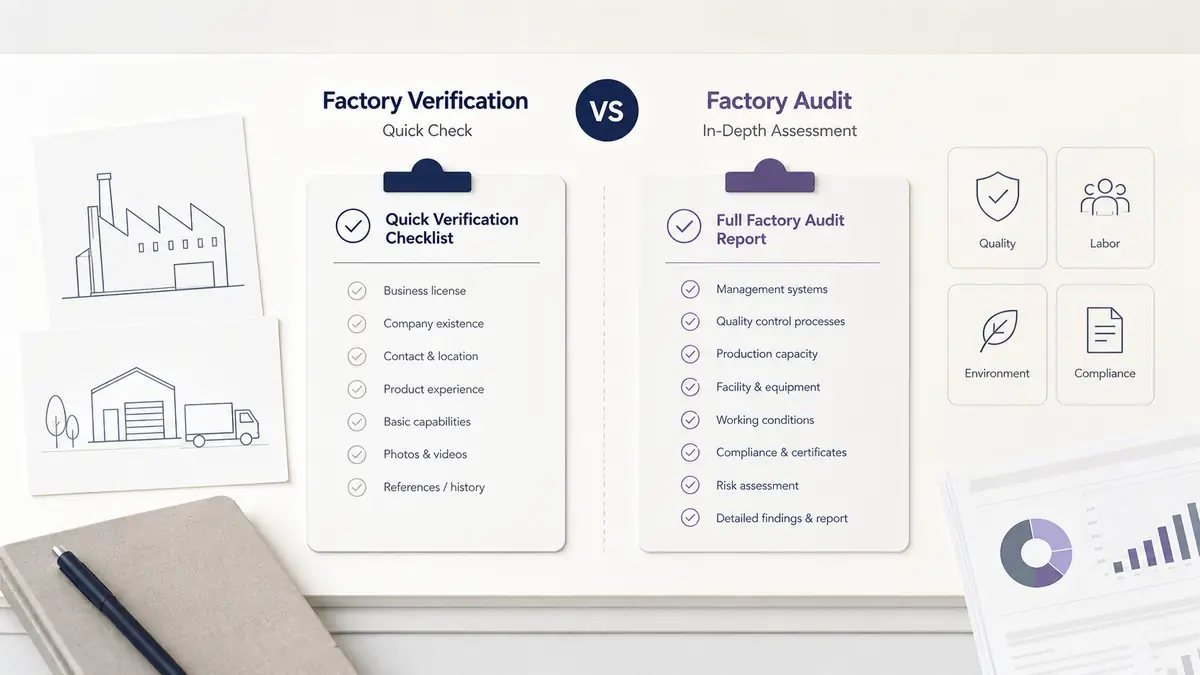
Buyers often use “factory audit” and “factory verification” as if they mean the same thing. They are related, but they solve different problems.
What factory verification checks
Factory verification is usually an early-stage risk check. It confirms whether the supplier identity, business license, product scope, ownership signals, export experience, and basic operating footprint make sense.
It is useful before a deposit, before sample approval, or when a buyer is deciding whether a supplier deserves deeper review.
Verification is also useful when the buyer is comparing several suppliers and needs to decide where to spend time. It can expose inconsistent company names, unclear payment beneficiaries, product pages that do not match the quoted item, or communication that suggests the supplier does not control production. These findings do not always prove fraud, but they help the buyer slow down before money moves.
What a factory audit checks
A factory audit is deeper and more formal. It can cover production management, quality systems, social compliance, equipment, documentation control, worker safety, process capability, and corrective action plans.
An audit is useful when the order is large, regulated, repeatable, or important enough to justify deeper review.
A physical audit can also check conditions that remote verification cannot see: whether equipment exists on site, whether production areas match the claimed process, whether quality records are maintained, how nonconforming goods are handled, and whether management systems are mature enough for repeat orders. The audit result can support supplier approval, corrective actions, or a decision to stop.
Practical comparison
| Question | Factory verification | Factory audit |
|---|---|---|
| Main purpose | Early supplier risk screen | On-site capability and system review |
| Timing | Before deposit, samples, or audit budget | Before major orders or supplier approval |
| Evidence | Documents, online signals, supplier replies, consistency checks | Site visit, production areas, records, equipment, staff interviews |
| Cost and speed | Usually faster and lighter | Usually slower and more expensive |
| Limit | Cannot prove actual site conditions | May still miss future production issues |
Which one should come first?
Most buyers should begin with verification. It is faster and helps avoid spending audit budget on a supplier that fails basic checks. If the supplier passes verification and the order justifies deeper review, an audit can follow.
There are exceptions. If the product is safety-critical, heavily regulated, technically complex, or strategically important, audit planning may start earlier. In that case, basic verification still helps define what the auditor should check and whether the supplier identity and payment details are coherent.
When travel is not practical, a remote factory and production check can be used as an intermediate step before an on-site audit.
How this connects to supplier selection
Verification should support the broader China supplier search process and should happen before final payment decisions. For deposit timing, use the supplier verification checklist.
The best approach is staged. Search identifies candidates. Verification removes obvious risk and clarifies open questions. Samples test product execution. Audit checks deeper capability when the order justifies it. Production follow-up then keeps the approved supplier aligned with the actual order.
Limitations and review
Neither verification nor audit guarantees perfect production. Supplier performance can change after approval, and even audited factories can make mistakes. The purpose is to improve the buyer’s decision quality, document risk, and define the next control point before payment or production.