
Packaging
Packaging requirements for China manufacturing orders
How to define packaging requirements for China suppliers, including carton marks, labels, inserts, durability, and shipment handling.
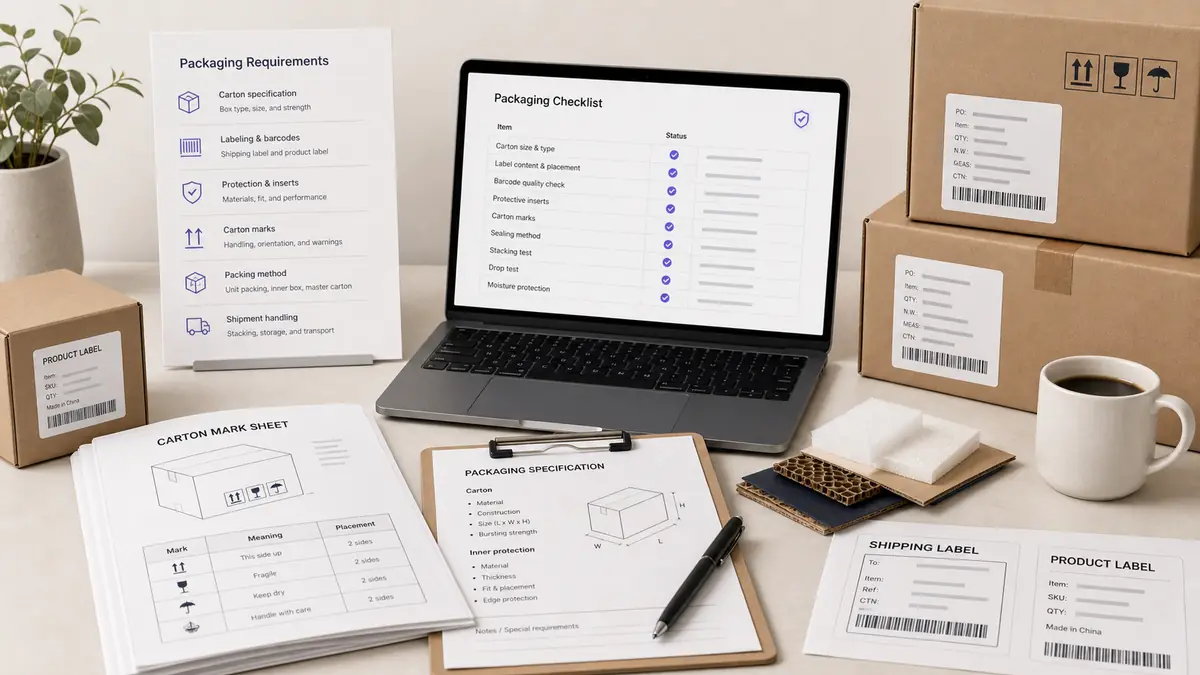
Packaging is often treated as a small detail until goods are damaged, mislabeled, delayed, or rejected by a warehouse. For China manufacturing orders, define packaging before production starts.
Define the packaging system
A packaging requirement should cover unit packaging, inner carton, master carton, inserts, labels, barcodes, warning marks, and any destination warehouse rules.
Define packaging as a system, not a single box. Unit packaging may affect retail presentation. Inner packaging may protect the product during handling. Master cartons affect loading, warehouse receiving, and freight cost. Labels and barcodes affect customs, marketplace intake, retail compliance, and after-sales traceability.
If the buyer has a warehouse guide, retailer requirement, or marketplace carton rule, it should be shared before quotation. Late packaging rules can change carton size, weight, label placement, materials, and cost.
Confirm handling needs
Packaging must survive real handling: factory packing, inland transport, container loading, ocean or air freight, customs checks, and final delivery.
Packaging checklist
- Unit packaging material and dimensions.
- Label position and barcode requirements.
- Carton size, weight limit, and carton marks.
- Inner protection, inserts, bags, or foam.
- Drop-test or durability expectations when needed.
Review packaging during samples
Packaging should be part of sample approval when it affects product protection, retail presentation, or compliance. A buyer can approve the product but still reject the packaging. That should be written clearly so the supplier does not treat product approval as packaging approval.
Ask for photos of unit packaging, inner protection, labels, barcode placement, carton marks, and master carton structure. If artwork is not final, approve only the structure and keep artwork open. If carton dimensions are important for logistics, ask the supplier to confirm the packed weight and size before mass production.
Connect packaging to inspection
Packaging should be reviewed during sample approval and again before shipment. If packaging is finalized late, the supplier may pack correctly made products in the wrong way.
Use this guide with the sample approval process and shipment handover documents.
For US-bound shipments, packaging data also supports customs clearance and final warehouse delivery planning.
For final pre-shipment checks, use a separate packaging and labeling control checklist.
Common packaging failures
Common failures include missing labels, wrong carton marks, weak master cartons, incorrect barcode placement, mixed variants in one carton, unapproved inserts, unclear warning marks, and carton weight that exceeds warehouse limits. These problems may not be visible in product photos, so they need their own checklist.
Packaging failures can delay shipment even when production is finished. They can also create extra cost at the destination if a warehouse must relabel, repack, or separate mixed goods.
Review note
This guide focuses on supplier communication and order control. It does not replace packaging engineering, hazardous goods review, retailer compliance review, or destination-market labeling advice where those are required.
Related procurement guides
- China supplier search process
- Factory audit vs factory verification
- How to compare China supplier quotes
- Trading company vs factory in China
- China supplier payment terms
- Sample approval process
- Production follow-up checklist
- Inspection readiness
- Shipment handover documents
- How to control packaging and labeling before shipment
- How to clear US customs without delays