
Supplier verification
China supplier verification checklist before sending a deposit
A checklist for B2B buyers who need to verify a China supplier before deposit, samples, or production.
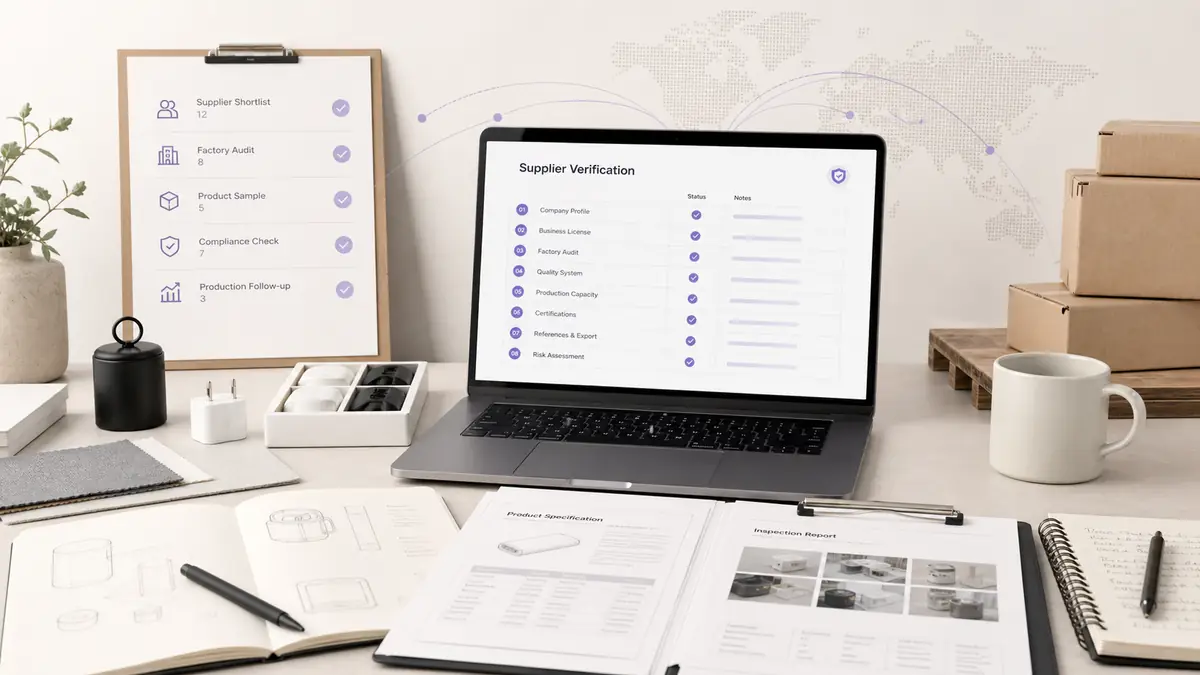
Before sending a deposit to a new China supplier, slow the process down and verify the evidence behind the offer. A low unit price is not enough. The real question is whether the supplier can make the product, document the order, control quality, and hand the shipment over without avoidable surprises.
Why supplier verification matters before payment
Supplier verification is where a sourcing project moves from conversation to evidence. Before any deposit is sent, confirm that the company, product capability, commercial terms, and production plan all support the same order.
If the supplier cannot document basic facts before payment, the same weakness usually appears later in sampling, quality control, or shipment handover.
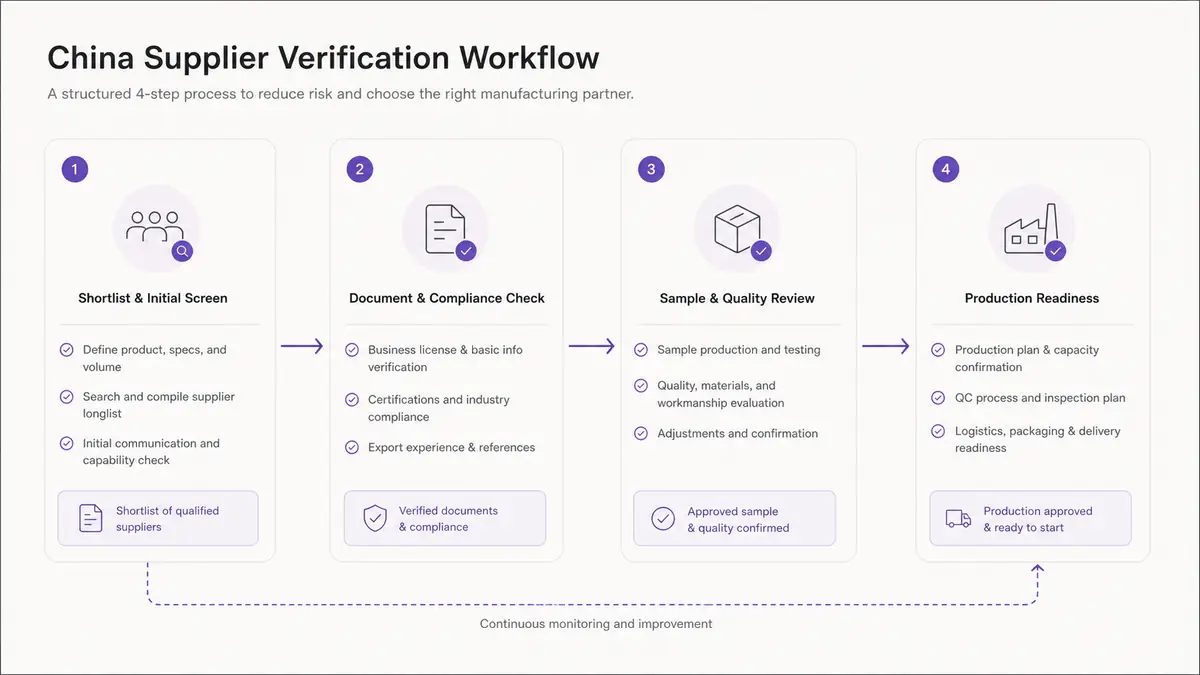
Step 1: Confirm the company profile
Start with the company profile. Match the English company name, Chinese business name, address, export contact, payment beneficiary, and business license details.
Red flags to pause on
- The payment beneficiary does not match the supplier record.
- The supplier changes company names during negotiation.
- The contact avoids sharing license or export details.
- The quoted product does not match the supplier’s visible production scope.
If these signals do not line up, ask for clarification before discussing payment.
Step 2: Check manufacturing fit
Next, check manufacturing fit. A trading company is not always a problem, but the buyer should know who actually controls production. Ask for product-specific photos, recent export references, capacity notes, and examples of similar materials, tooling, packaging, or certifications.
Manufacturing fit should be checked against the exact order, not the supplier’s general catalog. A supplier may be legitimate and still be a poor fit for the product. For example, a factory that handles simple standard items may struggle with tight tolerances, special finishes, private-label packaging, or destination-market documentation. The verification note should separate company legitimacy from product capability.
Ask the supplier to explain its normal production route, what is made in-house, what is outsourced, and where quality checks happen. If the supplier avoids these questions or gives only generic marketing answers, treat that as a risk signal before deposit.
Step 3: Treat samples as a decision gate
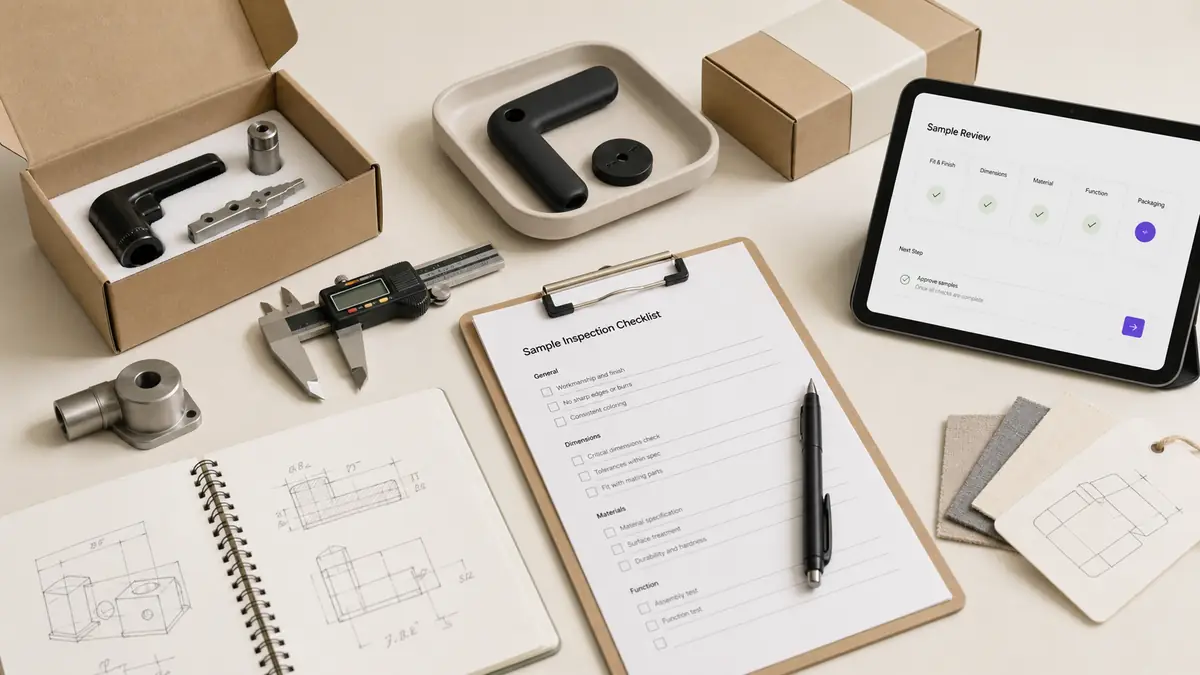
Treat samples as a decision gate, not a formality. Review dimensions, materials, workmanship, labeling, packaging, and function against the written specification. Record every change in a sample feedback log so the final approved sample can be tied to production requirements.
What to document during sample review
- Critical dimensions, tolerances, materials, and finish.
- Packaging structure, labeling, carton marks, and inserts.
- Functional issues, cosmetic defects, and agreed corrections.
- The exact version approved for production.
Step 4: Confirm production readiness
Before the deposit, confirm production readiness: agreed specification, final quotation, payment terms, lead time, inspection window, packaging files, carton marks, and shipment handover responsibilities. These details should be written in one order file, not scattered across chat messages.
Production readiness is where many rushed orders fail. The buyer may have a quote, a sample photo, and a payment request, but still lack the actual control file needed for production. Before paying, confirm which sample version is approved, whether packaging is final, what happens if inspection fails, which documents will be supplied, and who can approve changes after production starts.
If the supplier pushes for deposit before these points are clear, pause and ask why. Some urgency may be normal around material booking, but payment pressure should not replace basic documentation.
Match payment risk to verification depth
Not every order needs the same verification depth. A small standard sample order may only need basic identity and beneficiary checks. A repeat production order, regulated product, customized component, or high-value deposit needs a deeper process: company verification, sample approval, quote normalization, written order file, inspection plan, and possibly a third-party factory audit.
The key is proportional control. Verification should be strong enough for the money and operational risk involved. If the deposit is meaningful to the buyer, the supplier evidence should be meaningful too.
What verification cannot guarantee
Remote verification cannot guarantee that every production batch will be correct. It cannot physically inspect equipment, inventory, worker practices, process controls, or the actual condition of goods. It also cannot replace legal advice for contracts or compliance advice for regulated products.
What it can do is reduce avoidable uncertainty before payment. It can show whether supplier identity, payment details, product scope, sample behavior, and production claims are coherent enough to continue.
Final supplier verification checklist
Before sending a deposit, make sure the order file includes:
- Verified supplier identity and payment beneficiary.
- Product specification and approved sample notes.
- Final quotation, payment terms, and production lead time.
- Inspection plan and shipment handover responsibilities.
- Written record of open risks and who owns each next step.
Conclusion
A China supplier verification checklist does not remove all risk, but it makes risk visible early. Pause when a supplier avoids documents, pushes for fast payment, changes the company name, refuses sample corrections, or cannot explain the production schedule. The goal is not to find a perfect supplier. The goal is to make a supplier decision with enough evidence before money moves.
Editorial review note
This checklist is reviewed as a buyer-side operating guide, not as legal, customs, or compliance advice. It is designed to help B2B buyers organize supplier evidence, payment timing, sample approval, and order readiness before a deposit is sent.