
Factory verification
How to check a Chinese factory and production remotely
How buyers can verify a Chinese factory remotely using live video, document checks, production evidence, and third-party verification.
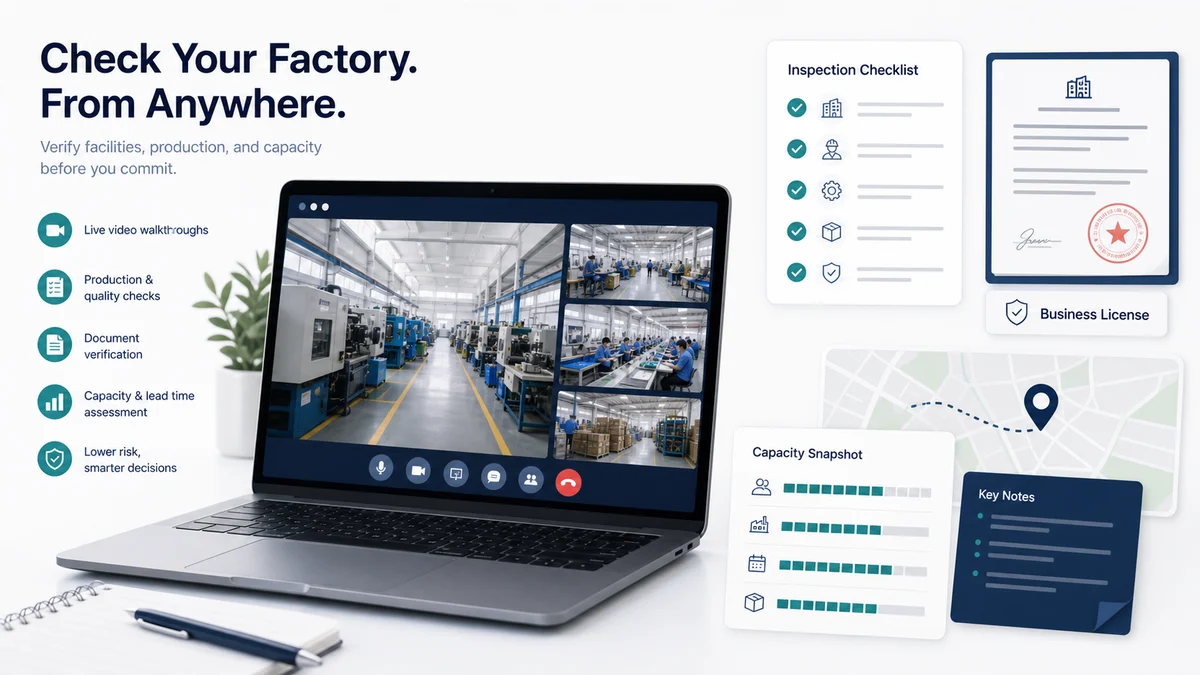
Remote factory checks help buyers reduce supplier risk before travel, audit budget, or a large deposit. They do not replace a full on-site audit, but they can expose inconsistencies early and show whether a supplier deserves the next step.
Confirm identity before the call
Start with the basics: company name, Chinese business license name, address, contact person, payment beneficiary, website, export record signals, and product scope. These details should match each other.
Ask the supplier to send a business license, factory address in Chinese, and the name of the company that will receive payment. If the bank beneficiary is unrelated, pause until the relationship is explained and documented.
This remote check should sit after initial supplier verification and before deposit or large sample commitments.
Use a live video walkthrough
A real-time video call is harder to stage than selected photos. Ask for a scheduled walkthrough of the entrance, company sign, production floor, relevant machines, raw material area, QC area, packing area, warehouse, and sample room.
What to ask during the walkthrough
- Show the building entrance and company sign.
- Walk from the office to the production area without cuts.
- Show machines relevant to your product.
- Show current work-in-progress, not only finished samples.
- Show QC tools, inspection records, and rejected goods area.
- Show packaging storage and carton mark examples.
If the supplier refuses live video but sends polished photos, that does not prove fraud. It does mean the evidence is weaker. Record the limitation and consider third-party verification.
Look for production evidence
The goal is not to admire a factory. The goal is to see whether the supplier can actually make your product at the expected quality, volume, and timing.
Ask for evidence that connects to your order: similar products in production, machine capability, material handling, fixture use, packing method, and quality checkpoints. Sample rooms can be misleading because they often show the best examples, not normal mass production.
If the product is custom, ask how the factory will control drawings, tooling, tolerance, color, labeling, and approval samples. Then connect those answers to a written product specification.
Check capacity signals
Remote capacity checks are imperfect, but useful. Ask about monthly output, active lines, shift pattern, material lead time, subcontracting, peak season constraints, and current order load.
The supplier should explain how your order fits into the schedule. A vague answer like “no problem” is weaker than a dated plan that shows material purchase, production start, in-process check, packing, final inspection, and shipment release.
Know what remote checks cannot prove
Remote checks cannot fully prove ownership, labor conditions, process discipline, long-term capacity, or future quality. They also cannot guarantee that the factory shown on video is the factory that will make your order.
Use remote checks as a filter. For larger, regulated, safety-critical, or repeat orders, follow with a third-party verification or on-site audit. The difference is explained in factory audit vs factory verification.
Decision rule
Approve the supplier for the next step only if identity, payment details, production evidence, communication, and capacity signals are coherent. If evidence is incomplete, reduce order size, delay deposit, request third-party verification, or continue searching.