
Quality control
How to control quality at every production stage in China
A staged quality control plan for China manufacturing from approved sample and materials to production checks, packaging, final inspection, and shipment release.
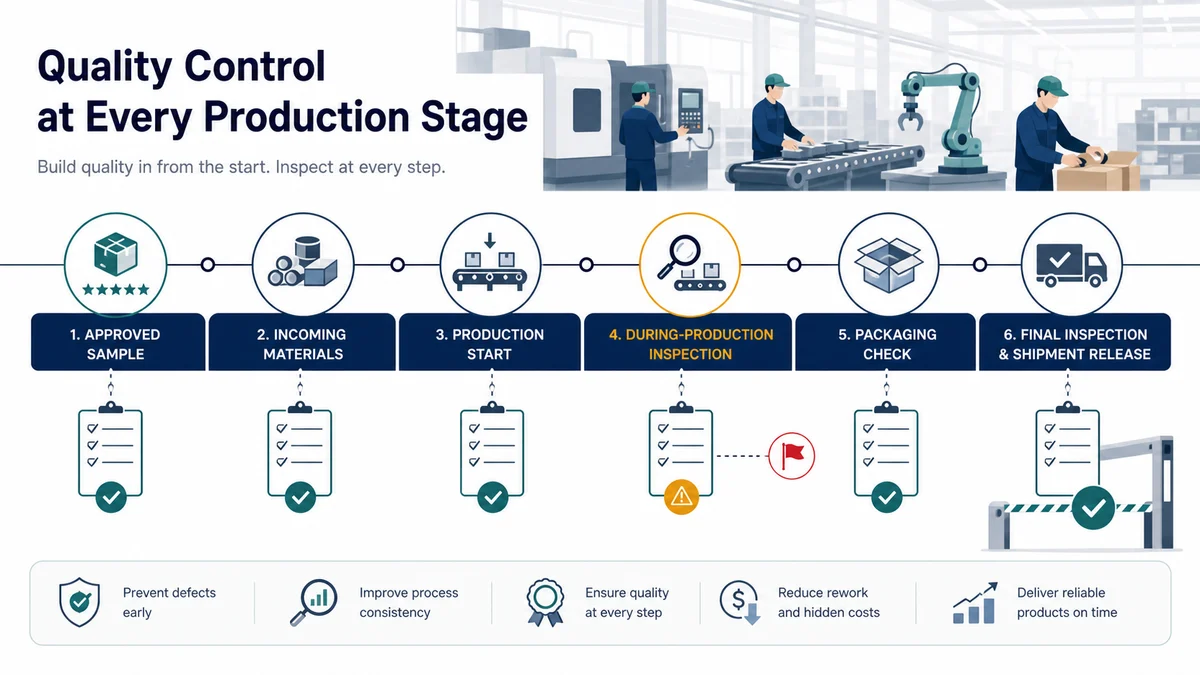
Quality control in China should not begin at final inspection. By then, the goods may already be packed, the schedule may be tight, and the supplier may pressure the buyer to release balance payment.
The stronger approach is staged control: define the standard, check early evidence, inspect during production when needed, and release shipment only when defects and documents are understood.
Stage 1: approved sample and production standard
Start with an approved sample, final product specification, packaging files, labeling requirements, testing rules, and defect definitions. The supplier should confirm that mass production will follow these documents.
The approved sample should be labeled with version, date, supplier name, and buyer approval status. If the sample has known exceptions, write them down. Otherwise, the supplier may treat those exceptions as acceptable in mass production.
Stage 2: incoming material check
Material problems are easier to fix before production starts. Ask for material purchase confirmation, supplier certificates when relevant, color or finish confirmation, and photos of incoming materials.
For technical or regulated products, consider lab tests or third-party checks. For simpler products, a documented material check may be enough. The level should match product risk.
Stage 3: production start confirmation
When mass production starts, ask for evidence from the first output: photos, videos, first-piece measurements, process setup, and any early QC findings. This is the moment to catch wrong color, wrong logo, wrong assembly, wrong packaging direction, or misunderstood tolerance.
If the first production pieces do not match the approved sample, stop and correct before the defect spreads across the order.
Stage 4: during-production inspection
During-production inspection is useful when the order is large, the schedule is long, the product is customized, or previous supplier performance is uncertain. It checks work-in-progress before everything is complete.
What to check during production
- Finished quantity versus planned quantity.
- Work-in-progress quality against the approved sample.
- Critical dimensions, function, color, finish, and assembly.
- Packaging material readiness.
- Defect patterns and corrective action.
- Revised completion and inspection date.
DUPRO is not needed for every order, but it is valuable when a final inspection would be too late to recover.
Stage 5: packaging and labeling check
Packaging defects can delay customs, retail delivery, warehouse receiving, or marketplace intake. Confirm unit packaging, inner carton, master carton, barcode, country of origin, warning labels, carton marks, pallet rules, and packing method.
Use the detailed packaging requirements before the factory starts packing.
Stage 6: final inspection and shipment release
Final inspection should happen after production is complete and most goods are packed, but before balance payment and shipment release. The inspection should compare actual goods to the approved sample, specification, packaging rules, and defect criteria.
If inspection fails, do not solve the problem through chat alone. Document defects, request a corrective action plan, define rework or replacement, and verify evidence before release. Use a written nonconformity process for leverage.
When volume increases, adjust QC frequency and supplier capacity checks before scaling the order.