
Product specification
How to write a product specification for a Chinese supplier
A practical product specification template for China sourcing, covering dimensions, materials, tolerances, packaging, labeling, testing, and approval control.
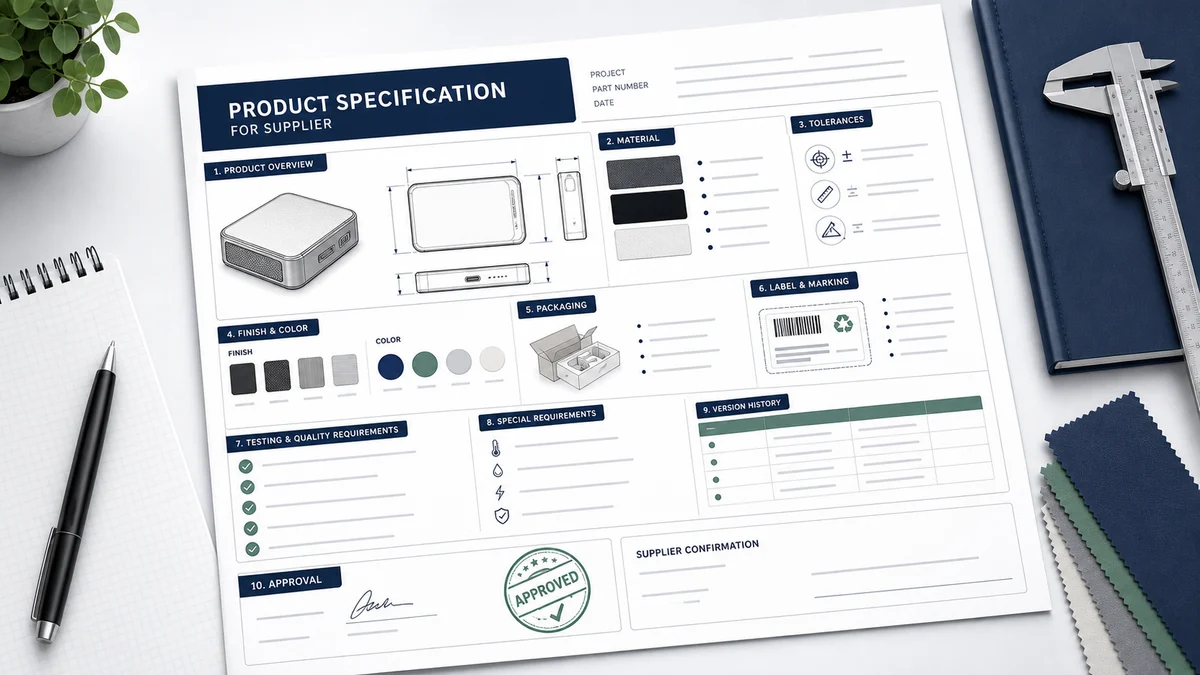
A product specification turns your expectations into a document a China supplier can quote, sample, manufacture, inspect, and correct. Without it, the supplier fills the gaps, and those assumptions often become disputes later.
Define the product clearly
Start with the product name, model, intended use, order quantity, target market, and whether the product is standard, modified, or custom. Add photos, drawings, reference samples, and competitor examples when they clarify the requirement.
Do not rely on screenshots alone. Screenshots help suppliers understand direction, but they rarely define materials, tolerance, finish, packaging, labeling, or test requirements.
Specify measurable requirements
Every important requirement should be measurable or visually verifiable. Use numbers, standards, photos, or approved samples instead of vague words.
Core specification fields
- Dimensions, weight, capacity, and tolerances.
- Material grade, thickness, density, or composition.
- Finish, texture, color standard, and surface treatment.
- Components, accessories, fasteners, and spare parts.
- Logo, artwork, labeling, barcode, and carton marks.
- Inner packaging, retail packaging, master carton, and pallet rules.
- Functional tests, safety tests, compliance requirements, and inspection method.
Words like “high quality,” “premium,” “strong,” or “same as sample” are not enough. If strength matters, define the load test. If color matters, use Pantone, RAL, fabric swatch, or approved physical sample.
Separate must-have from optional
Some requirements are fixed. Others can be optimized for cost, MOQ, or lead time. Tell suppliers which items cannot change and which items may be quoted as options.
For example, material may be fixed while packaging has two options. Or a finish may be fixed while accessory quality has good, better, and best levels. This helps suppliers give useful alternatives without quietly downgrading the product.
Add acceptance criteria
A specification should explain how the product will be accepted or rejected. Define critical, major, and minor defects when possible. State how mass production will be compared with the approved sample, drawings, packaging files, and test requirements.
This connects the specification to quality control at every production stage and to the sample approval process. A sample is useful only when it is linked to a written standard.
Control revisions
Use version numbers and dates. When something changes, update the specification and write what changed. Send the revised file to the supplier and ask for written confirmation that the quote, sample, production plan, and lead time still apply.
Revision control checklist
- File name includes product, version, and date.
- Each change has a short note.
- Old versions are not used for production.
- Supplier confirms the current version before deposit.
- Approved sample is labeled with the same version.
Many sourcing problems come from different teams using different files. Revision control is simple, but it prevents expensive confusion.
Keep the language clear
Use short sentences, tables, annotated images, and consistent units. If the order is important, prepare bilingual key fields or ask the supplier to confirm the Chinese interpretation of technical terms.
The goal is not legal complexity. The goal is a practical production document that reduces misunderstandings before quote, sample, deposit, inspection, and shipment.
For custom products, the specification should be attached to the supplier contract and aligned with any IP protection controls.
Related procurement guides
- How to brief a China supplier search
- How to make a contract with a Chinese supplier
- How to protect design, brand, and IP
- How to get samples and evaluate quality
- How to know if a supplier price is competitive
- Quality control at every production stage
- Packaging requirements
- Handling defective goods and nonconformity