
Quotation
How to know if a China supplier price is truly competitive
A practical way to judge whether a China supplier quote is fair, complete, and competitive after specs, MOQ, terms, and risk are normalized.
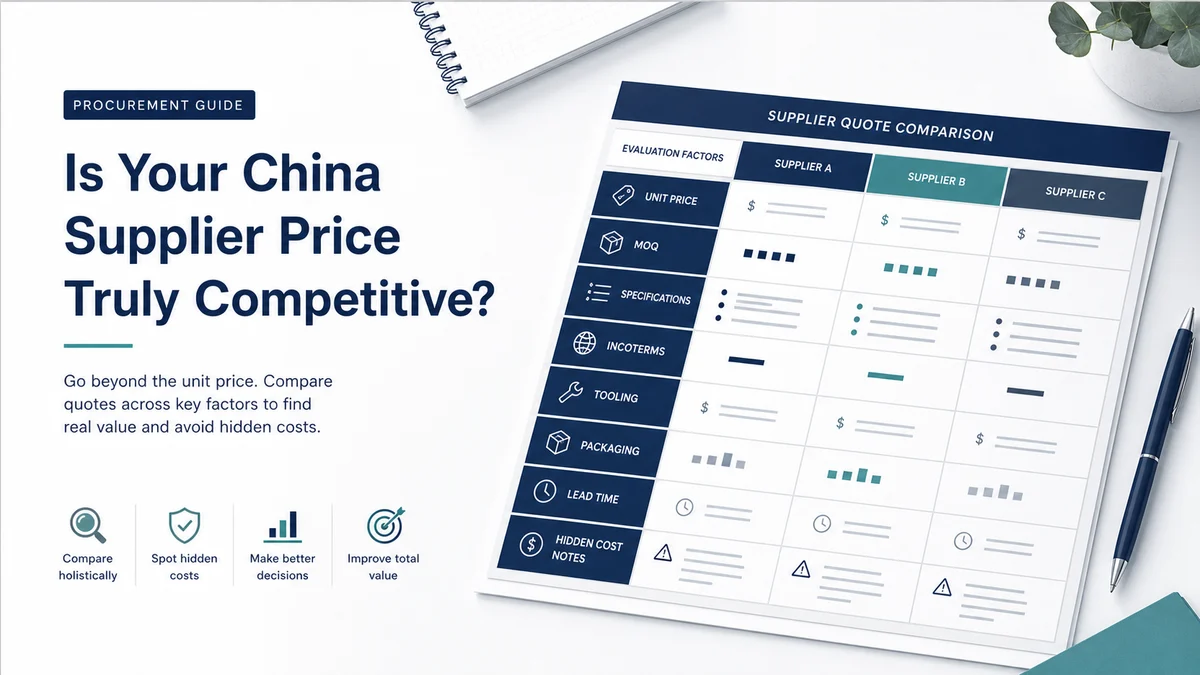
A China supplier price is competitive only when it is attached to the same product, same quality level, same commercial terms, and a realistic production plan. A low unit price can be a good offer, or it can be a sign that something important was excluded.
Start with like-for-like specifications
Do not compare prices until every supplier is quoting the same version of the product. Confirm material grade, dimensions, finish, tolerance, color, accessories, packaging, labeling, testing, certification, and reference sample.
If one supplier quotes a lighter material, simpler packaging, looser tolerance, or no testing, the offer is not cheaper. It is a different product. Ask every supplier to re-quote from one written brief before you judge price.
This is where a strong product specification prevents false savings. A vague brief usually creates a wide price range because each supplier fills the gaps differently.
Normalize the quote fields
Build a comparison table that separates the unit price from the conditions around it. The goal is to remove hidden differences before you make a decision.
Fields to compare
- Unit price, currency, and validity period.
- MOQ and price breaks at realistic order quantities.
- Tooling, mold, sample, and setup fees.
- Packaging and labeling cost.
- Incoterms, export fees, and handover point.
- Lead time after deposit and after sample approval.
- Payment schedule and inspection before balance payment.
A supplier quoting FOB Ningbo is not quoting the same commercial scope as a supplier quoting EXW Shenzhen. A quote with packaging included is not the same as a quote where retail packaging is “to be confirmed.” Treat every missing field as a cost or risk until it is clarified in writing.
Check the price against quantity and capacity
MOQ changes the meaning of a price. Some suppliers offer a low unit price only at a quantity that does not match your launch plan. Others quote a higher first order because they need to buy material, set up tooling, or absorb small-batch inefficiency.
Ask for price breaks at several quantities. If the curve looks unusual, ask what changes at each level: material purchase volume, machine setup, packaging print run, labor efficiency, or logistics. A transparent supplier can explain why the price changes.
Capacity also matters. A low price from a supplier that cannot handle the schedule may become expensive through delay, rework, or missed sales. Connect price review with remote factory and production checks before a large order.
Price the risk, not only the item
Two quotes can look close on paper while carrying different risk. A supplier with stronger samples, clearer communication, better documentation, and inspection acceptance may be worth a higher price.
Add a risk column to the comparison:
- Company identity and payment beneficiary are consistent.
- Sample quality matches the written specification.
- Supplier accepts staged quality checks.
- Lead time is specific and credible.
- Defect responsibility is written before production.
If a cheap supplier refuses inspection, avoids written details, changes assumptions, or pressures for fast deposit, the risk-adjusted price is higher than the unit price suggests. Use the supplier verification checklist before payment.
Use the full landed cost
A competitive supplier price is only one input in landed cost. Estimate inland freight, export charges, international freight, insurance, customs duty, tariffs, brokerage, port fees, inspection, warehousing, and domestic delivery.
For US-bound orders, the cheapest factory quote may not produce the lowest delivered cost if packaging increases dimensional weight, documents are weak, or the Incoterm shifts unexpected costs to the buyer.
Decision rule
Choose the supplier whose quote is complete, comparable, commercially clear, and operationally credible. Do not choose only the lowest unit price unless the specification, quantity, Incoterms, packaging, lead time, payment terms, and quality controls are all aligned.
Write a short decision note before deposit. Record the selected supplier, price assumptions, open risks, sample status, inspection plan, and what would trigger renegotiation.