
Supplier selection
How to choose between a factory, trading company, and sourcing agent
A practical comparison of factories, trading companies, and sourcing agents in China, including transparency, MOQ, complexity, communication, accountability, and verification.
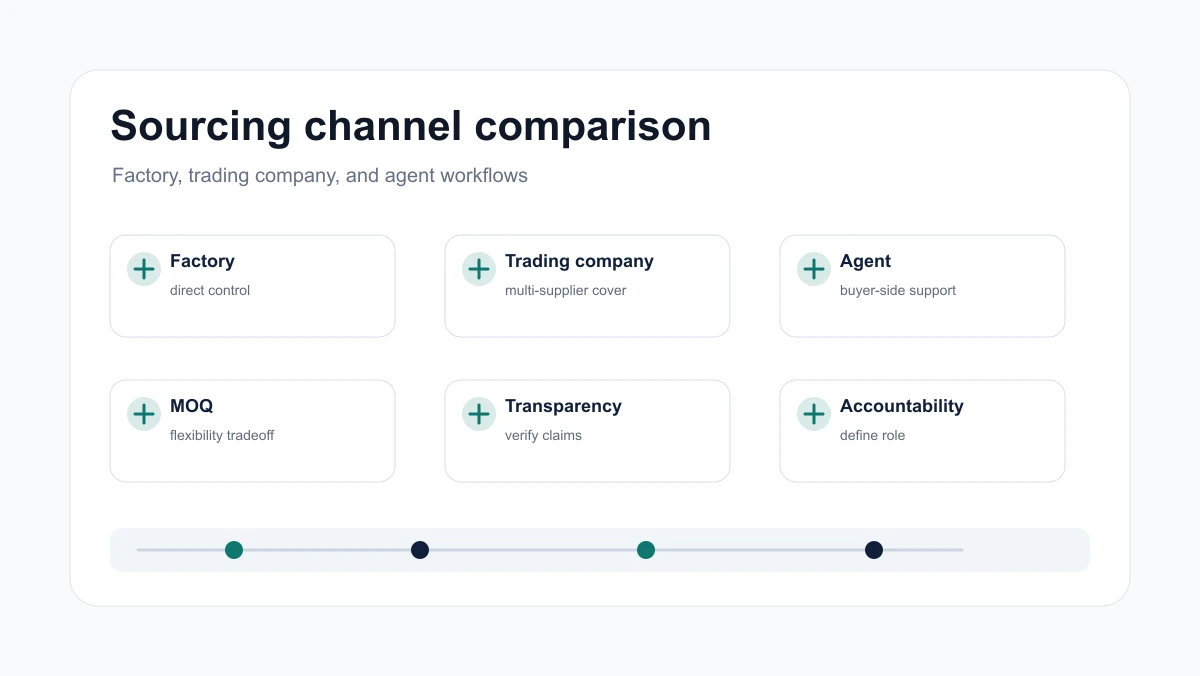
The right sourcing channel depends on what the buyer needs most: direct production control, supplier coverage, communication support, small-order flexibility, product development help, or independent oversight.
When a factory is the better choice
A direct factory is usually better for custom products, repeat orders, technical requirements, tooling, IP-sensitive work, and large volumes. The buyer can get closer to engineering feedback, production constraints, quality systems, and cost structure.
The tradeoff is buyer workload. The buyer must manage specifications, samples, follow-up, inspection, packaging, and shipment coordination more directly. MOQs can be higher, and communication may be slower or more technical.
When a trading company is useful
A trading company can be useful when the buyer needs multiple product categories, lower MOQs, faster sourcing, packaging coordination, or a single commercial contact. Good trading companies can filter factories, consolidate products, and manage documents.
The risk is transparency. The buyer may not know who actually manufactures the goods, what margin is included, or whether production issues are being filtered. Use verification and sample controls before deposit.
For a two-way comparison, see trading company vs factory in China sourcing.
When a sourcing agent is useful
A sourcing agent can act closer to the buyer side: searching suppliers, checking claims, managing communication, following up production, coordinating inspections, and escalating issues. This can be valuable when the buyer is new to China sourcing or lacks internal operations capacity.
The key question is accountability. Clarify how the agent is paid, whether they receive supplier commissions, who owns supplier contacts, who signs contracts, and whether the agent is responsible for quality, communication, or only introductions.
Whichever channel you choose, avoid building a sourcing process that depends on only one supplier or one relationship owner.
Decision table
| Buyer need | Best starting channel |
|---|---|
| Custom technical product | Factory |
| Many SKUs and small quantities | Trading company |
| New buyer needing local support | Sourcing agent |
| Strong IP or tooling control | Factory, with verification |
| Supplier search and comparison | Agent or trading company, then verify |
| Long-term scale and cost control | Factory |
Verify the role, not only the label
Some “factories” are trading companies. Some trading companies own or control factories. Some agents are independent, while others are paid by suppliers. Labels are less important than evidence.
Check business license, address, production evidence, payment beneficiary, sample quality, communication, and whether the supplier can explain production details. Use remote factory checks and supplier verification before deposit.