
US import documents
What documents are needed to import goods from China to the USA
A practical document checklist for China-to-USA imports, including commercial invoice, packing list, BL or AWB, arrival notice, customs bond, entry summary, certificates, and compliance records.
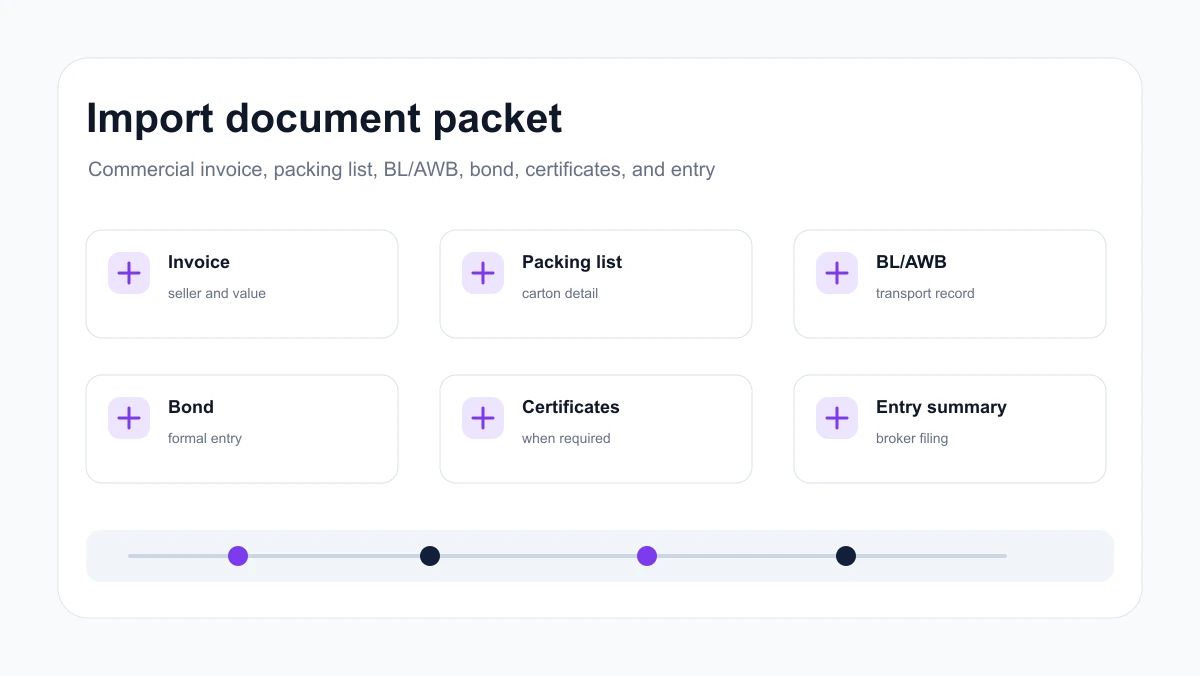
The documents needed for a China-to-USA import depend on the product, shipment mode, Incoterm, carrier, broker, and agency requirements. Most shipments start with a core document set, then add product-specific records when needed.
This article is a practical checklist, not customs advice. Ask your customs broker which documents apply to your product and entry type.
Core import documents
Most commercial shipments need a commercial invoice, packing list, and transport document. The broker may also need importer records, customs bond information, arrival notice, and entry data.
Common document set
- Commercial invoice with seller, buyer, product, quantity, value, currency, and Incoterm.
- Packing list with carton count, weights, dimensions, and SKU detail.
- Bill of lading for ocean freight or air waybill for air freight.
- Arrival notice from carrier or forwarder.
- Customs bond for formal entries where required.
- Entry summary and broker filing records.
- Duty and fee payment records.
The commercial invoice and packing list should match the supplier order, payment records, carton labels, and shipment handover file.
Product-specific documents
Some products require extra documents. Examples can include test reports, certificates, agency registrations, declarations, labeling proofs, origin records, material declarations, safety data sheets, or licenses.
The requirement depends on the product. Electronics, children’s products, food contact goods, chemicals, medical items, batteries, textiles, wooden packaging, and regulated goods may need more review than simple non-regulated merchandise.
Documents from the supplier
Ask the supplier for document drafts before the cargo leaves the factory. The supplier should confirm product descriptions, quantities, carton counts, gross and net weight, dimensions, country of origin, manufacturer details where needed, and packing photos.
Use this with shipment handover documents so the forwarder and broker are not correcting basic data after pickup.
Documents from the forwarder and broker
The freight forwarder usually manages booking, transport documents, arrival notice, cargo release coordination, and delivery data. The customs broker manages entry filing, classification review, duty calculation, and CBP communication.
Make sure both parties have the same invoice, packing list, Incoterm, shipment terms, and delivery address.