
Supplier risk
How to find backup suppliers before you need them
How buyers can build backup supplier options in China through search criteria, shortlists, verification, sample benchmarking, RFQ comparison, warm relationships, confidentiality, and activation triggers.
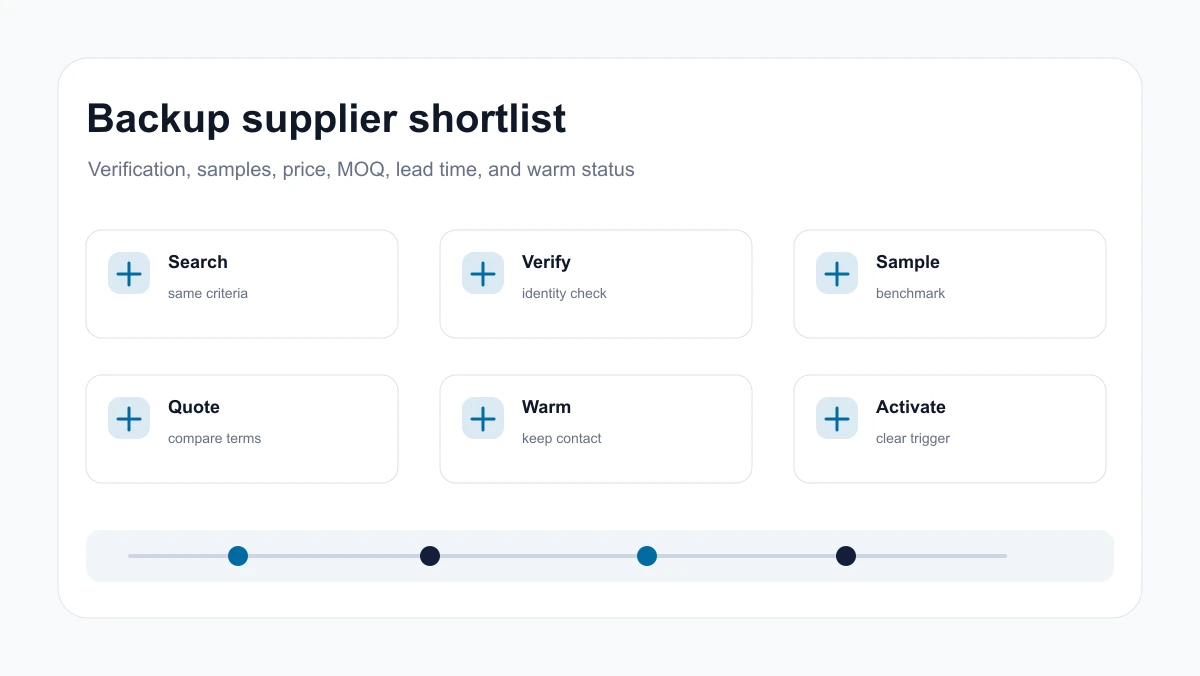
Backup suppliers are easiest to find before there is a crisis. If the current supplier is already late, refusing rework, raising prices, or holding tooling, the buyer has less time and less leverage.
Start from the same specification
A backup supplier should quote and sample against the same product file as the primary supplier. Otherwise, the buyer cannot compare quality, price, MOQ, lead time, packaging, or compliance risk.
Use the current product specification, approved sample notes, packaging rules, and inspection criteria as the search baseline.
Build a shortlist
Search for suppliers that match the product category, process, material, quality level, export market, and order size. Do not only search for the lowest price. A backup supplier must be capable of taking over under pressure.
Shortlist fields
- Company name, address, and product scope.
- Factory, trading company, or agent role.
- MOQ and realistic capacity.
- Similar product evidence.
- Verification status.
- Sample score.
- Quote assumptions and lead time.
Use supplier verification before sending sensitive files or deposits.
Benchmark samples
A backup supplier is not real until they can make a usable sample or show credible production evidence. Compare sample quality, dimensions, materials, packaging, function, and communication against the primary supplier.
If the backup sample is not ready for production, record what must improve before activation.
Keep backups warm
You do not need to place large orders with every backup supplier. But you should keep contact active, update specs when major changes happen, and periodically confirm capacity, pricing direction, and lead time.
For strategic products, consider a small pilot order or partial allocation to keep the backup supplier operationally familiar with the product.
Define activation triggers
Write down when the backup becomes active: quality failure, repeated delay, price increase beyond threshold, payment risk, capacity shortage, tooling dispute, compliance issue, or customer demand increase.
Without triggers, teams often wait too long and start backup sourcing only after the main supplier has already failed.