
Landed cost
How to calculate full landed cost with shipping, duties, and fees
A landed cost formula for China-to-USA imports, covering unit cost, packaging, China charges, freight, insurance, duties, tariffs, brokerage, port fees, delivery, and defects allowance.
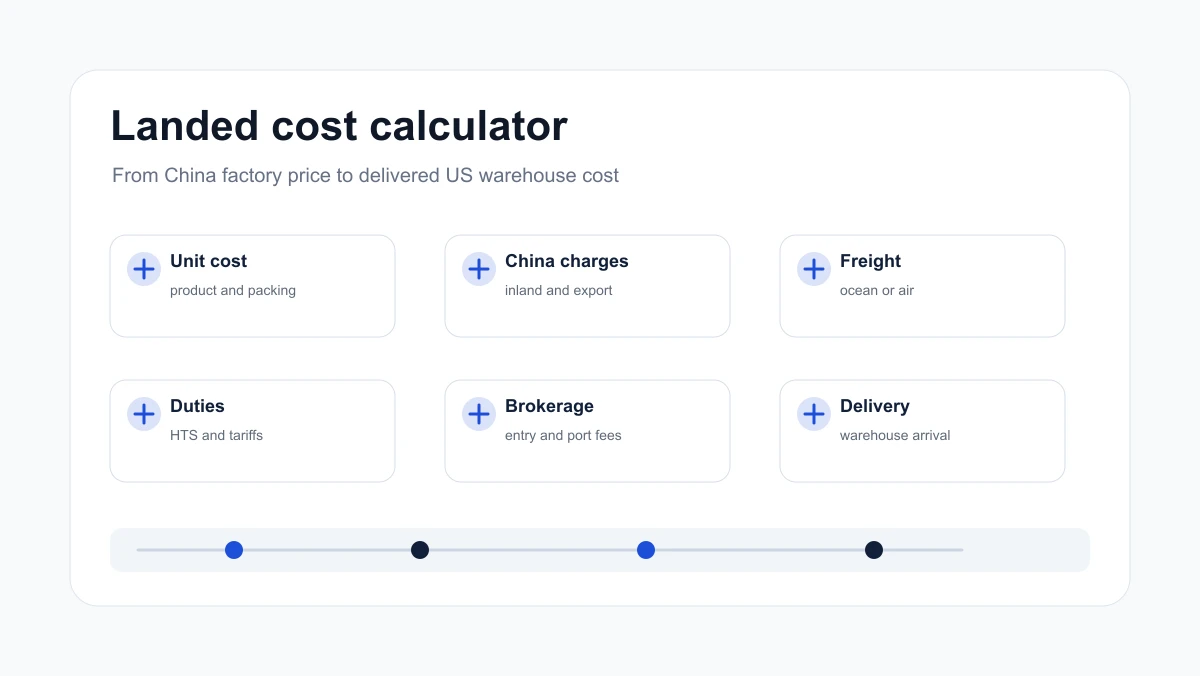
Landed cost is the total cost to get imported goods from the supplier to the buyer’s US warehouse or final receiving point. It is the number buyers should use when deciding whether a China supplier price is truly competitive.
This guide is not customs or legal advice. For classification, duty rates, Section 301 applicability, exclusions, and entry requirements, work with a licensed customs broker and check official CBP and USTR resources.
Landed cost formula
Use this working formula:
Landed cost = product cost + packaging + China inland/export costs + international freight + insurance + duties/tariffs + brokerage/entry fees + terminal/port fees + US delivery + quality/returns allowance
Then divide the total by sellable units, not just ordered units. If you expect defects, returns, samples, replacements, or unsellable units, include that allowance.
Start with supplier-side costs
Supplier quotes often hide differences. Separate product unit cost, packaging, tooling, molds, sample charges, labeling, carton marks, inspection support, and any supplier-side document fees.
The Incoterm matters. EXW, FOB, CIF, and DDP shift different costs and responsibilities. Do not compare supplier quotes until the Incoterm and handover point are clear.
Add freight and insurance
International freight depends on mode, volume, weight, route, season, and service level. Ocean freight may be cheaper per unit but slower. Air freight may be necessary for samples, urgent replenishment, or high-value small goods.
For ocean shipments, include origin charges, freight, destination charges, terminal fees, and drayage or final delivery. For air shipments, include air freight, handling, customs entry, and final delivery.
Add duties, tariffs, and entry costs
US import cost depends on HTS classification, country of origin, customs value, duty rate, and additional tariffs where applicable. Some China-origin goods may be subject to Section 301 duties or other trade remedies. Applicability can change by product, HTS code, exclusion status, and current policy.
Use official sources such as CBP Section 301 trade remedies FAQs and USTR Section 301 information with your customs broker before final costing.
For broader restriction review, check US tariffs and trade restrictions before confirming the supplier.
Include operational risk
Landed cost should include likely operating costs, not only freight and duty. Add inspection, re-inspection, sorting, repacking, labeling corrections, document correction, storage, demurrage risk, and defect allowance when relevant.
If a supplier has weak quality control, the landed cost may be higher than the quote suggests. Connect landed cost with quality control and nonconformity handling.
Simple landed cost checklist
- Supplier price and currency are confirmed.
- Packaging and labeling are included or priced separately.
- Incoterm and handover point are clear.
- Freight quote is based on real weight and dimensions.
- HTS code and duty rate are checked.
- Section 301 or other tariffs are checked where applicable.
- Brokerage, terminal, port, and delivery fees are included.
- Defect, return, and unsellable unit allowance is included.
Related procurement guides
- How to know if a supplier price is competitive
- US tariffs and trade restrictions
- How to choose Incoterms
- How to compare China supplier quotes
- How to negotiate price and MOQ
- Packaging requirements
- Shipment handover documents
- How to organize logistics from China to the USA
- China supplier payment terms